
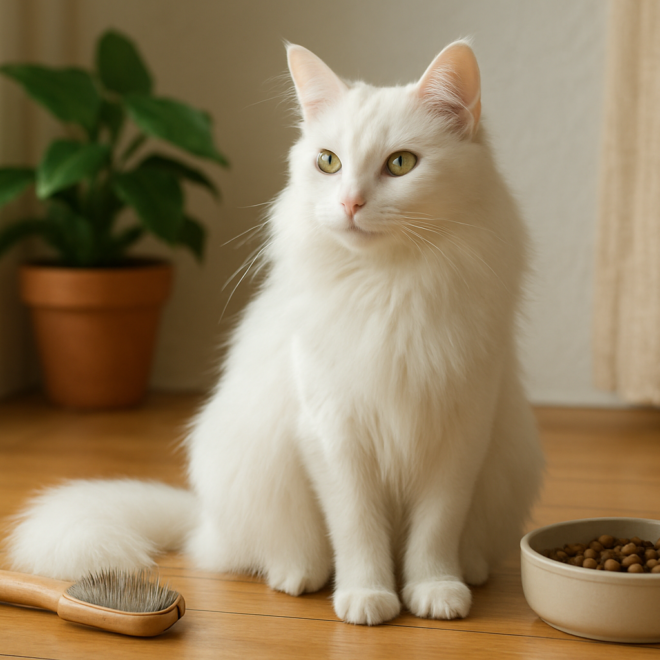

This blog’s been reviewed by Dr. Meera Iyer, BVSc & AH, MVSc, a professional veterinarian and Veterinary Wellness Advisor at Pawscuit — Small Animal Practice (Bombay Veterinary College).
With 5+ years of clinical experience in advising pet parents on budgeting for vaccines, sterilisation, nutrition, and emergencies, Dr. Meera has reviewed this Turkish Angora Cat price guide so that the medical and cost information stays accurate and realistic for Indian families.
Turkish Angoras are one of the oldest natural cat breeds, but genuine documented lines are still rare in India, which means ‘turkish angora cat price in india’ searches turn up a lot of generic long-haired cats wearing a more distinguished name. There is also a specific genetic detail about this breed’s most famous look worth knowing before you buy.
The short answer: how much does a Turkish Angora cost in India?
A local Turkish Angora kitten, where limited breeding exists, typically costs ₹15,000 to ₹30,000. Kittens from a documented breeder run ₹30,000 to ₹60,000. Imported cats, including the famous odd-eyed white variety, can reach ₹60,000 to ₹1,50,000+.
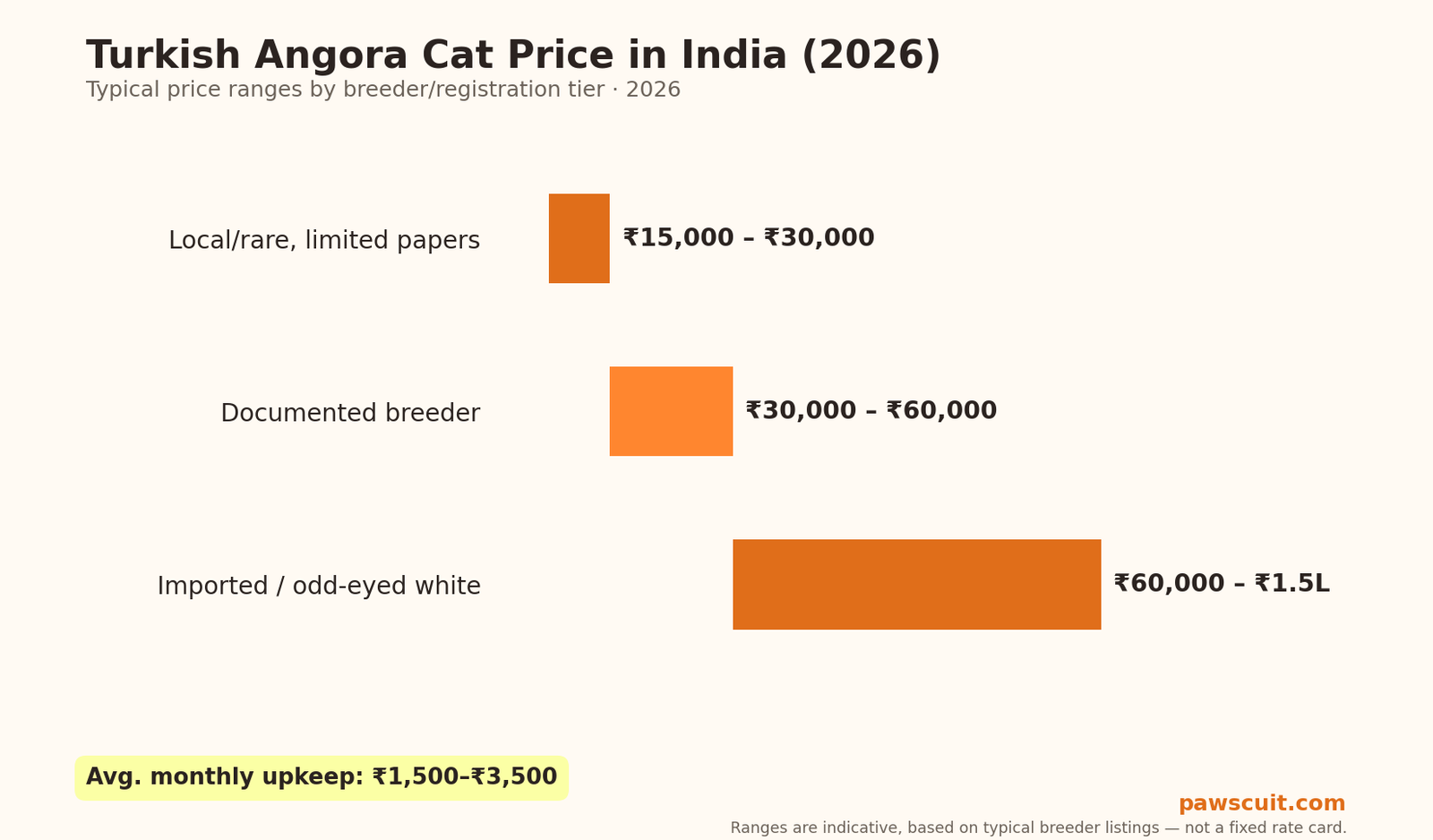
The odd-eyed white variant, one blue eye and one gold or green, is the breed’s most iconic look and its priciest, for reasons worth understanding.
The genetic link between white fur, blue eyes, and hearing
The gene responsible for solid white fur in cats is also connected to inner-ear development, and white cats, particularly those with blue eyes, have a well-documented higher rate of congenital deafness. In odd-eyed cats, one blue eye and one differently colored eye, deafness sometimes affects only the ear on the blue-eyed side, sometimes both ears. This is a genuine, researched genetic association, not superstition, and it is worth asking a breeder directly whether kittens have had a basic hearing check, especially for the striking odd-eyed white Angoras this breed is famous for.
Spotting a genuine Angora versus a generic longhair
A real Turkish Angora has a fine, silky single coat, notably different from the dense double coat of a Persian or Maine Coon, along with a slender, elegant body and a wedge-shaped head. A lot of fluffy domestic mixes get sold under the Angora name simply because true documented lines are uncommon locally. Ask about the coat texture specifically and request any lineage documentation before paying breeder-level prices for what might be a generic longhair.
What actually moves the price
Color and eye pattern. Odd-eyed white commands the highest prices, purely on rarity and demand.
Documented lineage. Given how thin genuine breeding is, paperwork carries real weight.
Hearing verification. Breeders who test kittens’ hearing, particularly white ones, deserve to charge more for that added assurance.
| Monthly expense | Approximate cost (₹) |
|---|---|
| Food | 1,000 – 2,200 |
| Grooming (light, low-mat coat) | 300 – 700 |
| Litter | 400 – 800 |
| Vet checkups, preventives | 500 – 1,500 (averaged) |
Buying vs. adopting
Genuine Turkish Angoras rarely appear in Indian shelters given how uncommon documented lines are, though fluffy white or light-coated domestic cats with a similar look often do, at a fraction of the cost.
A few questions worth settling first
Why are odd-eyed white Turkish Angoras linked to deafness?
The white-fur gene is connected to inner-ear development, giving these cats a documented higher rate of deafness.
How do I know if a cat is a genuine Turkish Angora?
Look for a fine, silky single coat, slender body, and wedge-shaped head, plus documentation.
Are Turkish Angoras high-energy cats?
Generally yes, more playful and active than calmer long-haired breeds.
Do Turkish Angoras need heavy grooming?
Less than expected, since their coat does not mat as readily as a Persian’s.
I’m not a veterinarian — I’m a pet parent and content researcher. Everything above is meant to help you ask better questions, not replace a vet’s or a reputable breeder’s judgment. If you are considering an odd-eyed white kitten, asking about a hearing check is a reasonable, informed question, not an overreaction.