

This blog’s been reviewed by Dr. Meera Iyer, BVSc & AH, MVSc, a professional veterinarian and Veterinary Wellness Advisor at Pawscuit — Small Animal Practice (Bombay Veterinary College).
With 5+ years of clinical experience in advising pet parents on budgeting for vaccines, sterilisation, nutrition, and emergencies, Dr. Meera has reviewed this Cat price guide so that the medical and cost information stays accurate and realistic for Indian families.
Every ‘cat price in india’ search eventually runs into the same confusing spread: some listings say zero, some say ₹8,000, some say ₹80,000, for what all get called simply ‘a cat.’ The honest answer is that price in this space depends almost entirely on which of three very different categories you are shopping in, and most guides do not separate them clearly. Here is the actual budget picture, plus links to the detailed breakdown for each breed we cover in depth.
The three real categories, and what each costs
Desi or street-lineage cats are India’s native, non-pedigreed cat population — genetically diverse, generally hardy, and available through shelters or rescue groups for ₹0 to ₹3,000, often including first vaccinations.
Common pedigreed breeds like Persians and Siamese, which have some established local breeding, typically run ₹8,000 to ₹30,000 for a pet-quality kitten.
Rarer or import-dependent breeds like Maine Coons, Ragdolls, Sphynx, and Scottish Folds, where genuine local breeding is thin, usually cost ₹30,000 to ₹80,000+, sometimes considerably more for documented, imported lines.
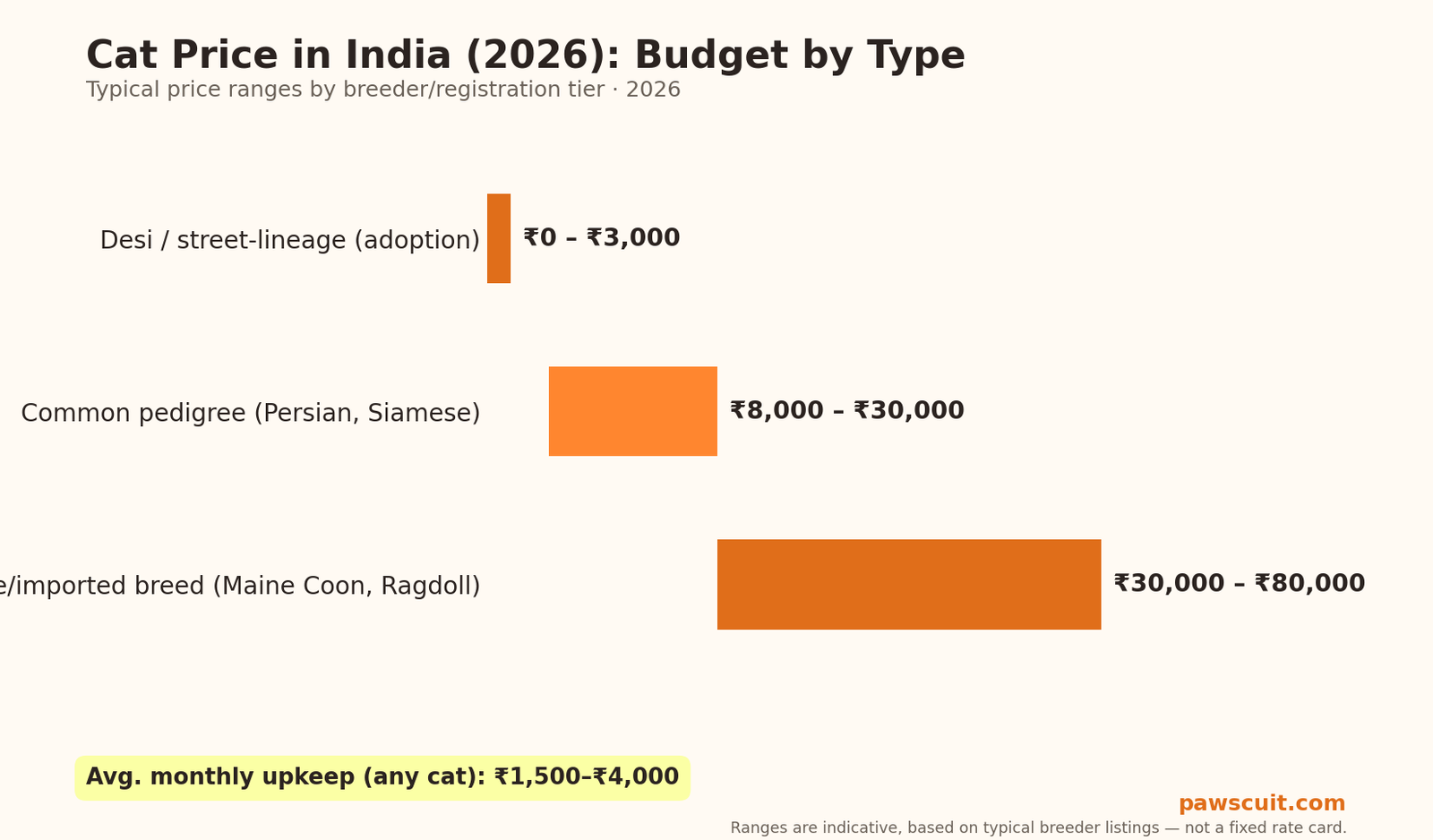
Where you land in that spread should depend less on what looks cutest in a reel and more on what you are actually looking for: a specific look and documented lineage, or simply a companion.
Why desi cats deserve more consideration than they get
There is a strong pull in Indian pet culture right now toward foreign pedigreed breeds, but it is worth saying plainly: desi cats are, on average, healthier. Their wide, naturally mixed gene pool means they largely avoid the specific inherited problems that come from generations of selective breeding within a small population — flat-faced Persians struggling to breathe, Scottish Folds developing painful joint disease from the same gene that folds their ears, and so on. A desi cat will not come with a documented pedigree, but it also will not come with those particular built-in risks.
Price guides for specific breeds
| Breed | Typical range (₹) |
|---|---|
| Persian | 8,000 – 1,20,000 |
| Maine Coon | 20,000 – 1,50,000 |
| Ragdoll | 25,000 – 2,00,000 |
| Munchkin | 25,000 – 2,50,000 |
| Bengal | 15,000 – 2,00,000 |
| British Shorthair | 12,000 – 1,20,000 |
| Siamese | 6,000 – 80,000 |
| Scottish Fold | 15,000 – 1,50,000 |
| Sphynx | 25,000 – 2,50,000 |
| Russian Blue | 15,000 – 1,50,000 |
The cost that does not depend on breed
Whichever category you choose, ongoing costs look fairly similar once you adjust for coat length and size:
| Monthly expense | Approximate cost (₹) |
|---|---|
| Food | 800 – 2,500 |
| Litter | 400 – 800 |
| Vet checkups, preventives | 400 – 1,500 (averaged) |
| Grooming (breed-dependent) | 0 – 1,500 |
Over a cat’s lifetime, this ongoing cost typically outweighs whatever you paid upfront, regardless of which category you started in.
A few questions worth settling first
What is the cheapest way to get a cat in India?
Adopting a desi kitten through a shelter or rescue, usually for ₹0-₹3,000, often including first vaccinations.
Is a pedigreed cat healthier than a desi cat?
Not usually — desi cats’ diverse gene pool tends to avoid the breed-specific issues selective breeding introduces.
What is the real ongoing cost of owning a cat in India, regardless of breed?
About ₹1,500-₹4,000 a month for food, litter, and routine vet care, usually more over a lifetime than the purchase price.
Should I buy a kitten or adopt an adult cat?
Adult adoption is worth considering — you can see the temperament and health upfront, and it is usually far cheaper.
I’m not a veterinarian — I’m a pet parent and content researcher. Everything above is meant to help you budget realistically and ask better questions, not replace a vet’s or a reputable breeder’s judgment.