

This blog’s been reviewed by Dr. Meera Iyer, BVSc & AH, MVSc, a professional veterinarian and Veterinary Wellness Advisor at Pawscuit — Small Animal Practice (Bombay Veterinary College).
With 5+ years of clinical experience in advising pet parents on budgeting for vaccines, sterilisation, nutrition, and emergencies, Dr. Meera has reviewed this Pomeranian price guide so that the medical and cost information stays accurate and realistic for Indian families.
Pomeranians are everywhere in Indian apartment-dog culture, and ‘pomeranian price in india’ searches turn up a specific, worrying trend: the smaller and cuter the marketing photo, the more likely you are looking at a health risk being sold as a feature. Here is what a Pomeranian should actually cost, and the one marketing term worth being wary of.
The short answer: how much does a Pomeranian cost in India?
A pet-quality Pomeranian puppy without papers typically costs ₹6,000 to ₹15,000. KCI-registered puppies from a documented breeder run ₹15,000 to ₹35,000. Show-quality Pomeranians, bred closer to the breed standard with full documentation, can reach ₹35,000 to ₹80,000.
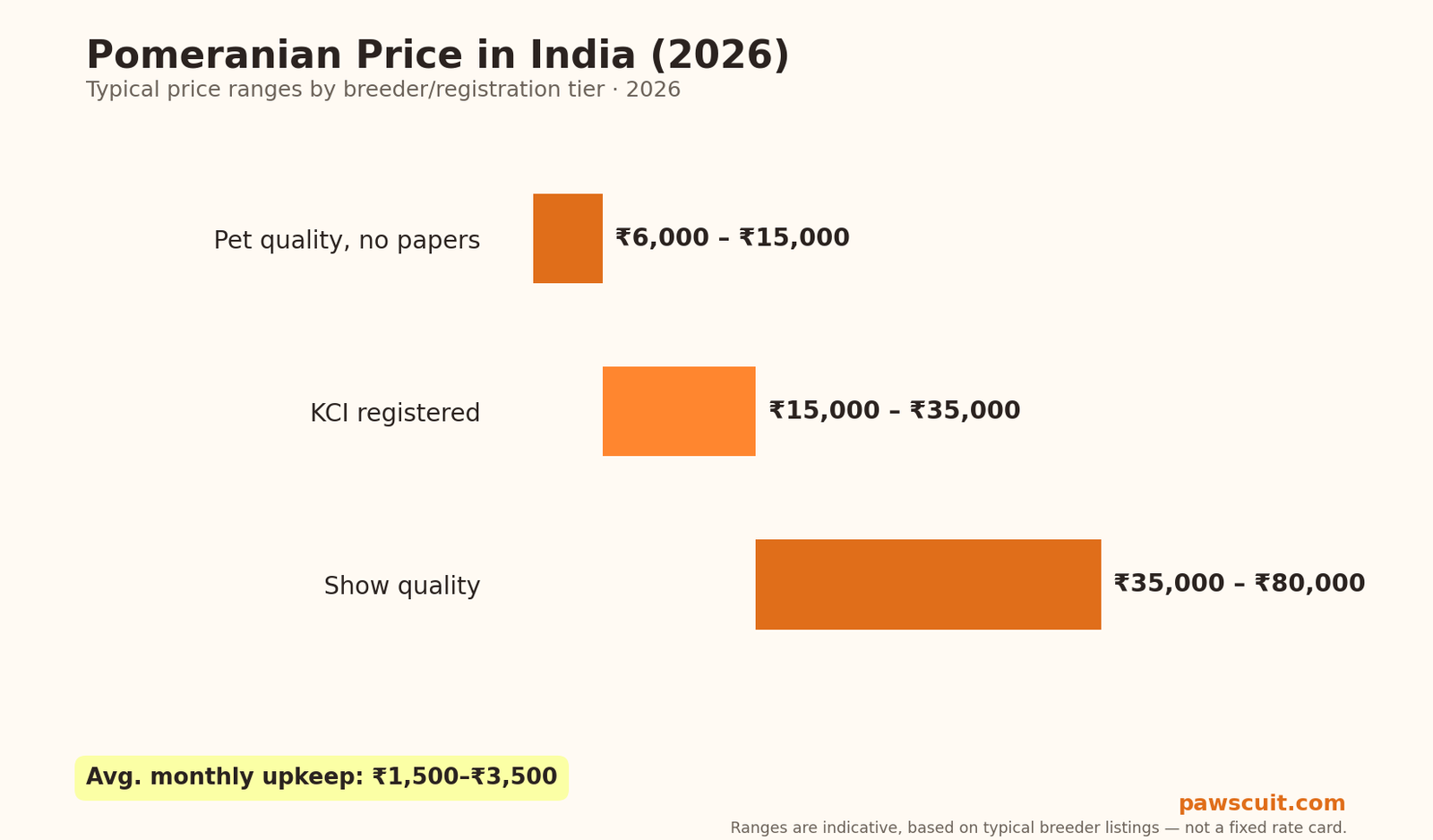
Notice that ‘teacup’ is not one of the tiers above. That is deliberate.
The teacup Pomeranian problem
‘Teacup Pomeranian’ is not a recognized breed variant, it is a marketing term for a dog bred to be smaller than the breed standard, sometimes deliberately, sometimes by selling the runt of a litter at a premium for its small size. Dogs bred or selected this way are more prone to fragile bones that fracture easily, dental crowding from a too-small jaw, and hypoglycemia, low blood sugar that can be dangerous in very small puppies. If a listing leads with ‘teacup’ as the main selling point, treat it as a reason for caution, not a reason to pay more.
Pomeranian or Indian Spitz? Check before you pay
The Indian Spitz, a distinct and locally common type not recognized by international kennel clubs, is frequently confused with the Pomeranian, and sometimes deliberately mislabeled since Pomeranians sell for more. A Pomeranian is smaller and more compact with a rounder head; the Indian Spitz is typically larger with a longer muzzle. If a puppy looks larger or longer-nosed than typical Pomeranian photos, ask directly what breed it actually is.
What actually moves the price
Size, done honestly. A genuinely well-bred, standard-size Pomeranian with good structure costs more than either an oversized Spitz-cross or an unhealthily undersized ‘teacup.’
Coat and color. Cream, orange, and merle patterns are currently the most sought-after and priced accordingly.
KCI registration. Confirms purebred lineage, useful given how often this breed gets crossed or mislabeled.
What it costs after the puppy comes home
| Monthly expense | Approximate cost (₹) |
|---|---|
| Food (small breed, smaller portions) | 800 – 1,800 |
| Grooming (heavy double coat) | 500 – 1,500 |
| Vet checkups, dental care | 500 – 1,500 (averaged) |
| Dental treats/care (small-breed teeth crowd easily) | 300 – 700 |
Small dental crowding and early tooth loss are genuinely common in this breed, teacup-bred or not, so factor dental care into your ongoing budget rather than treating it as a rare expense.
Buying vs. adopting
Pomeranians and Pomeranian-mixes do appear in Indian shelters, sometimes surrendered by owners who underestimated the grooming commitment. Adoption fees typically run ₹0-₹5,000.
A few questions worth settling first
Is a teacup Pomeranian a real breed?
No — it is a marketing term for undersized dogs, often linked to fragile bones, dental crowding, and hypoglycemia.
What is the difference between a Pomeranian and an Indian Spitz?
Pomeranians are smaller and more compact; Indian Spitz dogs are typically larger with a longer muzzle. They are commonly confused or mislabeled.
Do Pomeranians need a lot of grooming?
Yes — their thick double coat needs regular brushing and sheds heavily twice a year.
Are Pomeranians good with children?
Can be, but their small, fragile build means supervision around young children matters for the dog’s safety.
I’m not a veterinarian — I’m a pet parent and content researcher. Everything above is meant to help you ask better questions, not replace a vet’s or a reputable breeder’s judgment. If a listing markets a puppy’s small size as the main selling point, that is worth asking hard questions about first.